

Suppose you are at a critical point in your career, 10 to 15 years of experience, steady growth, but limited opportunities to move into leadership roles. You know upgrading your skills is essential, but quitting your job to study full-time is simply not practical.
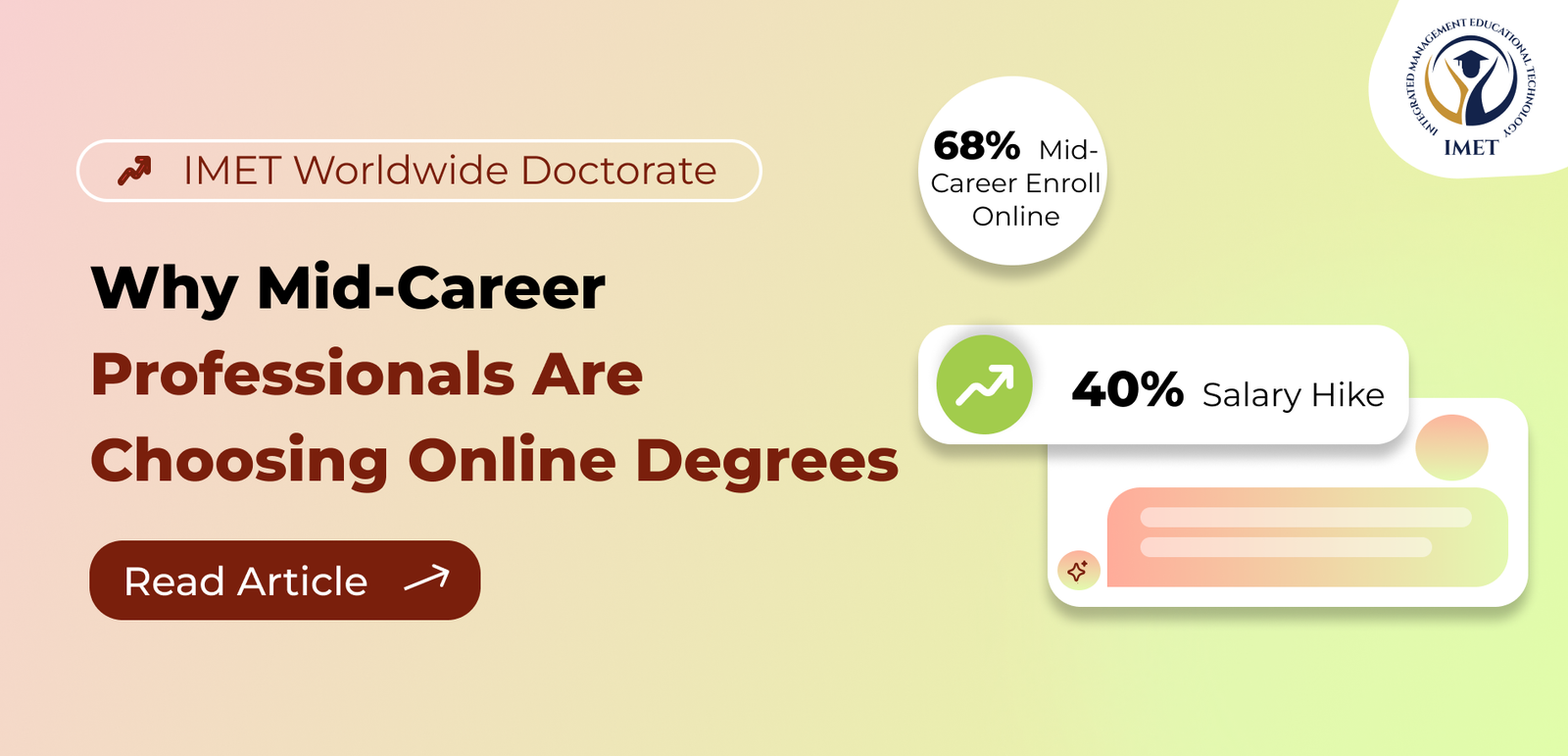
In 2026, this is exactly why mid-career professionals are turning to online degrees. They are no longer seen as secondary options—they are strategic career investments designed for growth without disruption.
Professionals today are focused on ROI, flexibility, and real-world relevance, making online education one of the most powerful tools for career advancement.
Why online degrees are rising among mid-career professionals
The modern workforce is evolving rapidly due to digital transformation, AI, and global competition. Mid-career professionals must continuously upskill to stay relevant.
Online degrees offer:
- Flexibility to learn without leaving a job
- Access to global programs and faculty
- Industry-aligned curriculum
- Faster career progression
Unlike traditional education, online programs are designed for professionals—not students fresh out of college.
The shift from traditional to flexible learning
Traditional education models often require:
- Full-time commitment
- Physical presence
- Career breaks
Online degrees, however, are built around working professionals:
- Weekend or self-paced learning
- Remote access from anywhere
- Integration with real work challenges
This shift reflects a larger trend—education is no longer a phase; it is a continuous process.
Career growth without career breaks
One of the biggest advantages of online degrees is the ability to earn while you learn.
Mid-career professionals can:
- Apply concepts immediately in their current roles
- Gain promotions during or after the program
- Transition into leadership positions
This eliminates the opportunity cost associated with traditional full-time education.
8 reasons professionals prefer online degrees
Online degrees have become the preferred choice due to the following benefits:
- Flexibility
Learn at your own pace without disrupting your job - Cost-effectiveness
Lower overall cost compared to traditional programs - Global exposure
Access to international faculty and peer networks - Career continuity
No employment gaps - Industry relevance
Programs aligned with current market demands - Immediate application
Apply learning directly to your job - Technology-driven learning
AI, simulations, and real-world case studies - Faster ROI
Promotions, salary hikes, and leadership roles
Salary impact and ROI of online education
Mid-career professionals are increasingly evaluating education based on return on investment (ROI).
Key factors influencing salary growth include:
- Relevance of skills gained
- Demand in the job market
- Leadership readiness
- Practical knowledge application
Online degrees—especially in areas like business, technology, and AI—are directly linked to higher earning potential because they focus on real-world outcomes.
Bringing it all together: career + flexibility
Online degrees combine the best of both worlds:
- Career continuity
- Skill advancement
- Leadership development
- Financial stability
They allow professionals to grow without stepping away from their existing responsibilities.
This is particularly important for individuals balancing:
- Work
- Family
- Financial commitments
Choosing the right online program
Not all online degrees are equal. The right program should align with your career goals.
Consider the following before enrolling:
- Accreditation and credibility
- Industry relevance of curriculum
- Flexibility and duration
- Faculty and mentorship
- Career outcomes and networking opportunities
Online programs are ideal for professionals who:
- Want to transition into leadership roles
- Aim for salary growth
- Need flexible learning options
- Want global exposure without relocation
Conclusion
The rise of online degrees among mid-career professionals is not just a trend, it is a reflection of how education is evolving in 2026.
Professionals are no longer willing to pause their careers for learning. Instead, they are choosing smarter, more flexible pathways that allow them to grow continuously.
Online degrees offer a powerful combination of convenience, relevance, and career impact. They enable professionals to upgrade their skills, increase their earning potential, and move into leadership roles without stepping away from their current careers.
As the demand for continuous learning increases, online education is becoming the preferred route for ambitious professionals who want to stay ahead in a competitive world.